The river finds a path to the sea
Regardless of the turn of clouds
or the distance of the shore.
Showing posts with label poetry. Show all posts
Showing posts with label poetry. Show all posts
Monday, 25 April 2016

Monday, 11 April 2016
NaPoWriMo #5: In Search of the Cartographer
We attempt to locate the cartographer,
he holds the map to his own
co-ordinates, leave no trace
through the lake.
Bethan says she saw him at a call of crows,
community can not decide how to write this
and so he remains lost.
I heard the sound of him
running past a stream
that wasn't there when the maps were drawn,
and so he remains lost.
We arrange to meet him by the oldest house
but he cut her down to count he rings,
and so he remains lost.
The cartographer hold the map to his own co-ordinates
ripped from the beat of the sun on the pavement,
the horizon line folded into his satchel,
and so we remain lost.
Thursday, 7 April 2016
NaPoWriMo #4: The chat-up Line
"A Ginger
is just a girl who hasn't had the fire fucked out of her yet"
Fight back
Earthquake Richochet
Heart sway to the beat of Celtic Hips
and Pray
you open bloodshot eyes to the cavalcade of Goddesses
that grace you with their presence
daily.
This hair is fire
my skin the whiteburn of ancient roots
Eyes the blue of grey rivers reflecting the moon
There is no in between
when you are the birth of elements.
If I am just the burning embers of a fire that hasn't been fucked out
follow my heat into the darkness
where many have tried before you
and failed.
Tuesday, 5 April 2016
NaPoWriMo #3: Pray, come.
Woman, come by the river to pray.
Pull Damp rag
Crimson tide
from your teething jaw/raw
and bathe.
Feel the water
raise/rise
it is purer after you pray.
Hand to knee
feel the rip of earth
clot/clod at the roots
of weeds and push/pull.
The river will erode/corrode
the limitations of its banks
and return to the sea.
The illusion/stability of land will cease
built upon chalk/drawn
against dark cavern face
illuminated only by lamplight/moonnight.
The River cuts down the façade of rock
to view its self-portrait
.
The Rock as a lover
breaks the confines of its frame to accommodate
harmony with the breeze.
Women, come by the river to pray.
See the true reflection of sisters in the time/sand
loosen the noose tension/lead weight beneath your chin
and pray.
Sunday, 3 April 2016
NoPoWriMo #2: Found Poem
Found
Play cook peas
Freezing taste near prayer.
Brothers Conversation say Danger.
Too late
Tower block swallow
Field mission, brave walking.
Poor crawling always
Found
Cloud
This will not run out
This strange dark
Highly present here.
This poem was inspired by an exercise at #WordsFirst with BBC1Xtra at Contact MCR
Friday, 1 April 2016
NaPoWriMo: Extract from 'Small Hands'
(...) In the back bedroom is a
box
China cracked and glued
back together,
Where my milk teeth sour.
I held them in small
hands,
quickly too big
and replaced the weight of
them
with Fairytales.
I’d never tell you
Just pull on loose teeth
And find magic in the
copper of blood
The barbed wire edge
We found you
In the back bedroom
Plaiting the hair of
Barbie dolls
When mine was knot and
hairspray backcomb
Tucking the whisper of
Childhood into bed at tea
time
As the door slammed behind
me
Guilt rose in a heartburn
chest
Where the dance floor
turned back to kitchen tiles
You said that ironing
Was a way of remembering
And smile when you found
opals in my mouth that I’d mistaken for teeth.
~ Natasha Borton
Monday, 7 March 2016

Wednesday, 22 April 2015
Review: Coleshill by Fiona Sampson

A collection for anyone Local. I don't mean local to Coleshill but local in the sense of community, of knowing potholes, of knowing Terry as a man and then as a ghost of himself walking down the main road home. Local.
This is a collection of rhythm, of human rhythm falling into place with nature. Of humans becoming the natural landscape - and isn't it about time? 'a phone rings' and the butterfly effect is set in motion as 'suddenly flocks of starling / are shuttling across the dark'.
There is a sense of enclosure. A trapping in the quaint countryside that isn't as safe as those outside it seem to believe as Sampson writes through the murder of a girl from the local nightclub. The girl in A Charm Against Knives could be the victim, it could be any of us; it could be the earth 'remember[ing] the whisper / of steel on skin'. That is all a murder has come to, in the grand scheme of nature one death is not unlike another, but the difference lies in the proximity of local.
When reading this collection I was reminded of myself, stood behind the bar of the local pub and scribbling poems on the backs of discarded receipts. Poems about the trees and trollies becoming part of the stream.
There is an important connection to made here that all we hold dear is cyclical, it belongs only to itself. Samspon sums it up in three striking lines 'Imagine bees falling from the sky - / yes, all of them. / Small scabs of air'.
I was struck by the density of Sampson's verse, how she can conjure up entire communities and dreamlands, present them simultaneously in a 'snow-globe' of understanding. She pierces the heart of the scenic to find the moment of hyper-reality that we don't often assume to belong to such picturesque location. It is this hyper realism that tips the border to the dream land for me. Such as in From the Adulterer's Songbook and the 'one / clear note, / / the night odour' - it's almost unbelievable, transported until you anchor it to real life experience, and then it all too true. Seeing the adulterer's legacy lengthen.
Monday, 20 April 2015
Review: Skirrid Hill by Owen Sheers
 From the cover I knew I was in for an exploration. The style of photography on the cover is called Body Landscaping, and it is when the object - often a human body - is made to look like an entire landscape on its own. In this case the shoulder and collar bones transformed into a valley, a hill, an estuary, a mountain. A landscape only too well known to many of us, iconic Wales.
'Skirrid Hill' is a exploration of familiar introspection that takes the reader by the hand and helps them navigate their own personal history. It is only fitting then that we begin at the 'Last Ac't. There is a feeling here that we are seeing the writer in a similar role to the actor 'bowing as himself for the first time all night.'. There is a distinct difference in confidence in Sheers second collection of poetry. A writer who is confident in his own raw emotion, confident even in the instability of image. The entire collection pivots on the grey area between having something, being one thing, and loosing it or becoming something else. Beyond that as the concept of the collection we see poems themselves altering before out eyes.
Poems like 'The Farrier', that in tandem throw images of the farrier carrying on his days work, and that of a bride on her wedding day, alongside the ambiguity of the horse. All images pulling together to deliver the fatal blow as 'The sound of his steel, biting at her heels'.
The winds of change are constantly blowing, I am older now than I have ever been and younger than I ever will be again. 'Inheritance' makes that abundantly clear, after the style of R.S. Thomas as Sheers ties in an incredible welsh poetic history to his work. 'From my father / ... / From my mother' here could mean the biological parentage or the rich heritage of poetry. the offspring, the barer of this tradition 'what they forged / in their shared lives;' - the heavy weight of this burden, but also the combined ancestry of it, a wonder that what humans really inherit from their families and from their environment, the collection continues to add to this image, speculating how we inherit the world around us and the skins of our old selves.
An interesting vein of this collection is Sheers's investigation of language. Wales is a fascinating hub of bilingualism, but it hasn't always been this way. Just as his first collection 'The Blue Books' hovered on the edge of languages with it's obvious rooting in the blue books of 1847,the discussion continues now. In 'History' set in the Lleder Valley of North Wales the blades of slate make a 'rusted, / metallic sound' telling the 'story of stone'. Here mixing the Welsh language both with the landscape as ever present and also making it Other, disconnecting it from any known language.
Sheers is one of my favourite writers both in Wales and generally. I devoured this collection.
Saturday, 11 April 2015
Review: New Light for the Old Dark by Sam Willetts
 I chose this book as part of the 2015 Reading Challenge, this is my book with antonyms in the title.
Titles are something I struggle with as a writer and a reader. A bad title, a telling title or just something unappealing can instantly turn me away from a book; I do tend to read books based on instinct or initial appeal and occasionally recommendations. They also have the power to get me excited about a book or a poem or a play. They can light the fire of curiosity. Recently an editor came back to me with lovely compliments about my poetry but she didn't like the titles, and it has taken me nearly two weeks to rework those titles. It's like imagining your best friend with a different name - doable but a difficult habit to break.
Anyway; this title 'New Light for the Old Dark' slowly reveals itself through Willetts collection. It is about looking at childhood, heritage and ancestry, and the self in a 'new light' and dispelling the preconceptions that we leave behind us in the 'old dark'.
The poems flow through Willetts own childhood, the upbringing of his mother's escape from the Nazis, and the redemption from a heroin addiction.
Willetts manages to convey these unbelievable events through smaller, familiar images which give the reader a foothold in his reality. From the image of a little girl against her mothers hem to a Redbreast, the Dublin messenger-bird, the reader is absorbed into the world presented and becomes an active participant in its unfolding.
There are moments of brutal perception in 'A Child at Their Party' when Willetts describes the scene as 'from a children's book written / by adults for themselves.' - what a wonderfully heartbreaking observation. One that takes us back to our own childhoods and how we remember them, but also, as children the reminder that we were never on our own authority and that in fact our memories and environments; that we often hold so dear, are merely constructs. Artificial nostalgia created by adults for the adults that they are, that we were to become.
The collection has a sense of loss about it, a sense of being the puppet, but this 'new light' shines onto the strings, and although we are the pawn in this big game of life and government it may actually be what we make of the 'old dark'; of our culture, history and within ourselves that breeds that light.
Tuesday, 31 March 2015
Windows
Today I started thinking about nature.
Nature often plays a part in my poetry, often in snippets, one reason for this could be that I see nature in snippets around me. A weed growing from between paving slabs, moss growing on the side of a decorative rock, a badger dead at the side of the road. I live in the biggest town in North Wales - not quite a country bumpkin, not quite a girl from the city - so today I'm looking at how I relate to that.
Windows
Tuesday, 3 March 2015
Englynion series: Cardiff
Cardiff
Take your time, enjoy it here.
Castle whispers in your ear.
Old meets new, it's any year
This is an Englyn Milwr, the rhyme scheme is a,a,a or monorhyme (which is when all end rhymes are the same) and each line contains 7 syllables (that is the tricky bit). This type of Englyn was popularized in the first world war and is also known as the Soldiers Englyn. The content is normally used to either praise or mock a person or as a declaration on love.
Here I use the Englyn to appraise Cardiff. I spent yesterday wandering around the city, something that I don't get to do often. I particularly like the clash of the old and new. On the edge of the city is Cardiff Castle,which blends with the horizon beyond the city and out across Bute park. In the middle is a labyrinth of side alleys, arcades, shops, streets and people and an eclectic mix of high end shops, high street regulars, independent and charity shops. There are three theaters, St. David's Hall, the Royal Welsh and the universities. It's a small city but one which seems open to younger generations, as if waiting for people to come and put their mark across it. It also stretches out towards the bay but I haven't been there for a while. Whenever I venture to the capital I feel a sense of 'welshness' that bordering on a hallmark card.
Sunday, 1 March 2015
Englynion series: Dydd Gwyl Dewi Hapus i pawb: Happy Sant David's Day everyone.
 |
| Sporting my spiffy Welsh Ladies Hat |
Throughout March I will be posting a series of Englynion (which are the British / Welsh equivalent of the haiku). I will discuss all things Cymru I have come to love and hate.

For now however I will leave you with the first Englyn I wrote, inspired by a brilliant poet and tutor Andrew Taylor and published in Erbacce's 2012 summer issue.
This is the poem that began my acceptance of and passion for English language Welsh poetry, a discovery I am grateful to for revolutionising my voice in poetry and leading me down the garden path.
I'm not nearly as Welsh as an Englyn,
Nor it's cynhanedd.
Mae hen wlad fy nhadau, Lloegr,
but I sing, yr ddraig goch, within.
This is a very rough Englyn, styled between Robert Davies' the Penfyr. I will also be trying different styles including the milwr, crych and lleddfbroest.
Trans:
I'm not nearly as Welsh as an Englyn
Nor it's cynhanedd
(essentially it's harmony, but more to come of this)
The land of my fathers, England,
but I sing, the red dragon, within.
Sunday, 22 February 2015
Review: The Cartographer Tries to Map a Way to Zion by Kei Miller

This was another random pick up from Wrexham Library (a
wonderful place in a town that really needs it - I can't speak highly enough of
this place). The title struck me first, The Cartographer Tries to
Map a Way to Zion, initially we are stuck with this battle between the
physical and the mythical and so we go into no mans land to watch each sides
interaction. In my work at the moment I'm trying to map both a people and a
place that no longer exist in the same forms; whilst tying their Welsh language
and it's clash with the development of the English language around them. So
this collection is speaking to me on many levels at the moment.
The poems jump of the page with
their use of language, the layout of the poems coupled with the rhythm of the
language opens the voice within your mind; allowing you to hear the battle
between them. Interestingly, Miller has a wealth of experience in Slam Poetry,
I wonder if the combat between the two speakers is a natural rhythm for him to
write in.
The blend of language is beautiful. On the one
side we have the Cartographer who is trying to anchor himself and his location,
pin his own language onto this land, he says 'my job / is not to loose
myself... My job / is to untangle the tangled', a wrench apart of physical
place. If we think about our own placement in the world and how tangled that is
to our emotional response, our memories, this is a very sad image
indeed. This is combated with the rastaman's mixture of
Rastaradianism and patois, drawing the reader into
his colloquialisms as he responds 'draw me a map of what you see /
then I will draw... Guess me whose map will tell the larger truth?'.
The battle between what is physically there,
and what a place actually represents is outlined clearly in the series of poems
that begin Place Name. particularly Flog Man where 'Blood did
sprinkle the ground like anointing' - as a poet I find it difficult to allow
myself to admit that there are many things, places, paths even people that can
not be described accurately by any use of language, things that 'are' cease to
be graspable, and that is their beauty. Possibly by describing the world around
them we can outline their shadow; but they will never flesh out. This is the
debate that the Cartographer and Rastaman find
themselves entwined in.
Miller's use of his heritage is
captivating. Knowing nothing of Jamaican literature or much of its culture I
was hesitant, but Miller guides us through. At the beginning I felt myself
clutching to the Cartographers poems, finding within them debates that I
contemplate daily. Within the Rastaman's narrative however, is a lilting
acceptance of things that come and go, an acceptance of not knowing and not
having to show others evidence of its existence.
The rastaman leaves us gently, he
'Bids you, Trod Holy / To I-ly I-ly I-ly'
Friday, 20 February 2015
Review: Mandeville by Matthew Francis

What i found fascinating was the aura of mystery that surrounds John Mandeville and his travels, an excellent jumping board for any creative to explore. Did John Mandeville really travel to these exotic and completely unfamiliar destinations? Are his accounts anywhere near accurate? Questions that have no necessary answer but that leave space for both the poet and the reader to jump into.
In Francis' collection there are lots of avenues. The imagery is often luxurious, at time's sufocatingly rich such as in Of Circumnavigation where the reader is traded between lands along with 'wool for spices, grey sea for blue, our brass for gold', to the point where the reader becomes almost travel blind with description.
There is very little subtly about each poem, the over arching journey is at best unessential. Instead I would look towards each poem as a case study, the arch being held in John Mandeville's own writing, this taking one fantastic element of each stage of his journey and unfolding it until it becomes something other than what it was, baring a tenuous likeness.
The collection is an intoxicating synaesthesic blend of 'cinnamon, cloves, nutmeg..culminating in a virgin sulphur.'. I've read many poetry collection that take the reader on a physical tour, but this is another experience that is tangibly liked to the earth in a way that conjurs the fantastical from familiarity. Francis' description of the dead sea uses familiar images and locations but uses anthropamorphism to conjur the spirit of the sea, as it has ' swallowed its tears and become parched by the salt'. - so beautiful!
The relationship between Francis and these objects is one of almost ownership, a claiming of their relation to other things, there is little delicacy, little right to their existence without his observing them. There is something harsh about the poem that is 'now tarnished ' by five hundred years of sandstorms' - of poets that alter colour.
Sunday, 25 January 2015
Dydd Santes Dwynwen Hapus! - Happy Saint. Dwynwen Day.
25th January is the Welsh Valentines day. Celebrating Saint Dwynwen, and her dedication to lovers. Stori Santes Dwynwen is fascinating and you can read a lot more of it on the BBC's website. Today I offer up a series of linked Englyn's, following in Robertson Davies' style, which you read more on here.
 In short Santes Dwynwen was the daughter of Brychan Brycheiniog, who fell in love with Maelon Dyfodrull. The two lovers planned to marry but Dwynwen's father forbade it. After this Dwynwen prayed to be let out of her love, and Maelon was turned into ice. As the story continues, an angel appears to Dwynwen and gives her three wishes. She wishes for Maelon to be free, that she will never marry, and that she could spend her life helping anyone in pain through love.
Dwynwen goes on to establish many Christian churches, along with her sister Cain and her brother Dyfnan. Dwynwen's own church is off Anglesey, Llanddwyn, the remains of the church are still there and people still travel to it to pray to Dwynwen to help them with their love.
The Englyn is a short Welsh and Cornish poetic form, similar to that of the Haiku.
Santes Dwynwen
Maelon, in your heart, do you still shiver,
from prayers icy dart
the angel of the river,
Brychan Brycheiniog's temper?
Maybe you dream, with me, at Llanddwyn,
a swollen memory
Angelsey, or an omen
of what we should have known, then.
But now you have gone, with Dyfnan and Cain,
and our sublime bygone,
to another place and time.
Here. I, mother to love's crime.
Thursday, 8 January 2015
Review: The Lilac Cellar by Diane Moore

Luckily my favourite element of this book in the title, it's a luscious placement of delicate darkness, which throws the reader right into grip of the poetry. The collection is described as being 'situated in the complex film-like zone between extreme, pure reality - and only a dream...' and interesting description of reality as pure, that in fact in being pure it becomes abstract. The collection follows the narrator through a series of events from loves lost, motherhood, death and the familiar ups and down's of life.
The authors own introduction is an interesting concept of poetic. Described as 'Poems of an anguished Winter, the expression of a woman's self-doubt, fifty days of immediate (non)-events and writing' setting the tone from the offset. Explicitly stating that the poems take place in non-events tricks the reader into finding events, from a writers perspective Moore is not using time specific triggered events as inspiration for her work, instead she is allowing the rollercoaster of her life to wash over her and out into her work. A Woman's self-doubt is another interesting concept, the poetry in this collection I would describe with feminine imagery, coming from a definite space of cultural stereotyping and oppression.
Noteable poems include Poem for Alla Pugacheva, opening with 'It is a melody played over a thousand times, / captured in the lilac mist / emerging from a metro station', which ties together a history of imagery with Ezra Pound's In a Station of the Metro. A synthetic journey through non-events. The use of colour in this collection is beautiful, such as 'my final tear of overdosed cyan' from Unearthed Love and Loss by using the cyan colour specifically it brings the language of photography or cinematography. The collection comes from a place of extreme reality in the sense that reality captured becomes hyperealistic.
Wednesday, 7 January 2015
Review: The Whole & Rain-domed Universe by Colette Bryce

The unusual cover and the theme of rain brought me to this book - research for my own poetry in progress on Capel Celyn but more about that later. I'm extremely glad to pick this up; as with most books the blurb is often shrouded in mystery but this blurb says exactly what you'll find inside.
Bryce presents a 'personal reckoning' of her life, family, environment and culture that is raw and cutting in places, putting Derry and the Troubles into a tangible poetic force for the reader. I'm particularly bowled over by her sense of place and space, highlighting the limitations and possibilities that are constantly at work between the writer and their origins.
I was captured from the first poem, White a beautiful quilt of poetry to swiftly pick up the reader in the folds of childhood, something we can all relate to, the importance of our development at this delicate stage speaks through 'the wordless place', which is a fascinating image for poetry, that does in fact convey up with words to a wordless space of images, scents, sounds and memory. The book more or less continues in chronological order, and I was pulled by the anchoring placement of some poems. After being conveyed to childhood Bryce takes us to Derry, a place that I have never been and hardly heard of, but paints a picture with very familiar colours, such as 'the sounds of crowds and smashing glass', it is the way that Bryce layers these images that make us feel at home.
We move quite quickly to the Troubles with The Analyst's Couch and the 'Blood... / like HP sauce' - such familiar images to describe uunfamiliarevents envelops the reader into the time and place. Growing up in Wales I can pull elements from the text that reminds me of my own life, which is a sign of a very good poet, to involve the reader actively in the story telling, like in Don't speak to the Brits, just pretend they don't exist and 'a wasp stings him on the tongue/ 'Tongue' is what they call the Irish language', images and context such as this makes the poetry very isolating, internal reminders and quite painful times I can imagine, spun into words of silver.
My absolute favourite poem of the book is one of the final ones, through quite a mature voice about a Mother A Simple Modern Hand, words taking the movement of writing and showing us that process. Crushing the hulk of words into dust that sings, the musicality in this poem with the 'mama - mama - emem - emem' dances from the page and moves the tongue in your mouth. The third section of this poem spells out the word Mother, forcing the reader to retrace their steps, like a reprieve in a song.
The overall accomplishment of these poems is one tellingly very personal to the poet, the characters she involves, the family they may represent, the place becomes a person in it's own right and guides the reader through the lives of it's inhabitants. By the end you are welcomed in, to pick up a pint or a cup of tea and join in with the story telling.
Thursday, 24 April 2014
People + Poetry
'People just don't read poetry'
'Poetry is hard'
'Poetry is dead'
I've been thinking about this a lot recently. About people who find poetry. People who ignore poetry. About people mainly and their interaction with poetry.
'People don't read poetry' in the last day or so I've been exploring Cardiff and Aberdare. As is necessary I've wandered into 6/7 book selling places, out of these 2 sold poetry. Mostly it was a poor effort. Mainly anthologies with names like The Nations Love Poems or The Poems You Can't Remember. A lot of effort goes into them I'm sure but I'm hardly ever given the opportunity to experience new names or even non-romantic poets! Maybe people aren't being given the means to experience poetry; particularly in small towns. Even worse, they are being put off by the archaic,
unrelatable poetry that was rammed down their parched throats in school!
'Poetry is hard' lets go here next. Poetry IS hard. It's also easy, it's unrelenting, it's romantic and selfish and giving. Poetry is anything you want it to be; and it's all around us, all the time. Your twitter rants rammed into 140 characters or whatever is poetry and flash fiction (you know the type)! Road signs and shorthand; it's all there. I see poetry as your ability to come to terms with the language around you, and within you. So yes; poetry is hard but it's necessary and it's yours.
it's alive and kicking
You
straight in the lips.
Crack
ing your skin
and your teeth
as you take a big old bite.
Doesn't the syrup just bite back?
Thursday, 17 April 2014
Hit the Ode Manchester
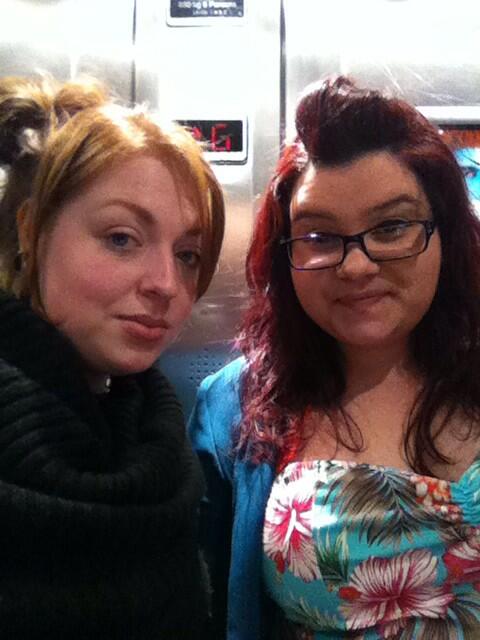
(Pippa and I with out In-the-lift-pre-poetry-selfie!)
Last night I had an amazing time at Hit the Ode Manchester edition. I'd heard a bit about this event on Facebook in the lead up and knew a bit about Apples and Snakes previously, but thanks to not being near any of the events I hadn't been able to experience these shows before. It was a night where I truly felt Spoken Word was on the rise. We hear a lot about how no-one likes poetry anymore and it's a dying art but last night proved that all wrong. A lot of the venue's we end up in are top rooms of pubs or small art cafe's, which are amazing and I enjoy my time there but it was really nice to see poetry on a bigger stage.
To begin with the event was so well organised. It was at Contact in Manchester, a venue I haven't been to before but one that I will be at again! The venue itself was perfect for the night, but I was sat at the front with my lovely friend Pippa!
The compares were brilliant, really funny and engaging. These nights have been going on for quite a while, a few years in Birmingham too, so they have a few traditions that they shared with us. It made us feel part of a poetic collective which was very empowering.
At the beginning was an open mic section with a few very organised people in the slots. These were very good poets and it really made you see how amazing some people out there are. There were also three slots for people who came on the night. Although neither myself or Pippa got to read the readers were great fun to watch.
The next bit of the show was more established performers.
 Rosie Garland performed first. Although I've read her work I only had the chance to see her perform at Loose Muse briefly so it was a pleasure to see her do a full set. If I'm honest this is the main reason I wanted to go! She didn't disappoint! Amazing stage presence and beautiful poetry, really a cracking combination. Garland's poetry is stuffed to the brim with gems of imagery with poems like
about (but not about) unicorns, topped with her very funny poems like being a Teenager in Devon and satirical work like Queer Thanksgiving which made me laugh and question society all at the same time!

Next was Jamine Cooray, a spoken word artist I hadn't hear before. It was refreshing to hear something different! Cooray takes vivid imagery from her childhood and disperses it throughout her work, she has a very modern style that can objectively examine itself well. I was particularly impressed with her self-made poetry pamphlets which were adorable and a great idea.
Last but definitely not least was Shane Koyczan.

I'm ashamed to say I hadn't really heard him before. I feel like I've seen his face on youtube and shared around but I hadn't taken the time to sit down and listen to his poetry. In a way I'm glad of this because the performance was so new to me I appreciated everything, the movement of his hands blended seamlessly into his poetry. I'm not ashamed to say I teared up a bit with his poem about his Grandad!
I really hope there are more of these to come! Check these amazing artists out on youtube and elsewhere!
Subscribe to:
Posts (Atom)