Showing posts with label Review. Show all posts

Monday, 29 June 2015

Review: Jump by Paula Kelly-ince


I have some wonderfully talented friends.

There is a sweet feeling in watching someone accomplish and succeed. Particularly when you have spent the last few years slogging it out with them and following them every step of the way.

One of my brilliant friends (be jealous, it's okay) runs a hilarious blog  and on this blog Paula Kelly-Ince has released the first section of her long awaited short stories collection.


Jump: Stories of Life, Love and Fear is a gentle whirlwind of emotions and lovable characters. Each story is beautifully crafted to lull the reader into its reality, slowly manipulating itself into a gut punch.

From Jump, which I have had the privileged of seeing performed, you hear the unnerving voice of a woman on the edge, both metaphorically and literally. I won't give the game away but her beautifully traumatic voice rings with a survival that inspires.

On top Tara, like watching strangers connect for the first time on the next street over. Two people devouring each other in conversation. It is like opening up.

To the final story in this collection Mr. Philips, which will remind everyone of 'that' high school crush and how we truly live through our experiences.

The three stories together tell a lot about female experience, giving strong voices to the often sidelined characters and providing weighted feathers to the reader.

Make this your Summer read. Then revisit it in Winter and Spring and Autumn. Show it to your grandparents and your daughter because there is something here for every season and for everyone.

Did I mention that I have wonderfully talented friends?

Again the link for a FREE PDF of these three stories is HERE

Wednesday, 22 April 2015

Review: Coleshill by Fiona Sampson


A collection for anyone Local. I don't mean local to Coleshill but local in the sense of community, of knowing potholes, of knowing Terry as a man and then as a ghost of himself walking down the main road home. Local.
   This is a collection of rhythm, of human rhythm falling into place with nature. Of humans becoming the natural landscape - and isn't it about time? 'a phone rings' and the butterfly effect is set in motion as 'suddenly flocks of starling / are shuttling across the dark'.
  
 There is a sense of enclosure. A trapping in the quaint countryside that isn't as safe as those outside it seem to believe as Sampson writes through the murder of a girl from the local nightclub. The girl in A Charm Against Knives could be the victim, it could be any of us; it could be the earth 'remember[ing] the whisper / of steel on skin'. That is all a murder has come to, in the grand scheme of nature one death is not unlike another, but the difference lies in the proximity of  local.
     When reading this collection I was reminded of myself, stood behind the bar of the local pub and scribbling poems on the backs of discarded receipts. Poems about the trees and trollies becoming part of the stream.
    There is an important connection to made here that all we hold dear is cyclical, it belongs only to itself. Samspon sums it up in three striking lines 'Imagine bees falling from the sky - / yes, all of them. / Small scabs of air'.
    I was struck by the density of Sampson's verse, how she can conjure up entire communities and dreamlands, present them simultaneously in a 'snow-globe' of understanding. She pierces the heart of the scenic to find the moment of hyper-reality that we don't often assume to belong to such picturesque location. It is this hyper realism that tips the border to the dream land for me. Such as in From the Adulterer's Songbook and the 'one / clear note, / / the night odour' - it's almost unbelievable, transported until you anchor it to real life experience, and then it all too true. Seeing the adulterer's legacy lengthen.

Monday, 20 April 2015

Review: Skirrid Hill by Owen Sheers

From the cover I knew I was in for an exploration. The style of photography on the cover is called Body Landscaping, and it is when the object - often a human body - is made to look like an entire landscape on its own. In this case the shoulder and collar bones transformed into a valley, a hill, an estuary, a mountain. A landscape only too well known to many of us, iconic Wales.
   

  'Skirrid Hill' is a exploration of familiar introspection that takes the reader by the hand and helps them navigate their own personal history. It is only fitting then that we begin at the 'Last Ac't. There is a feeling here that we are seeing the writer in a similar role to the actor 'bowing as himself  for the first time all night.'. There is a distinct difference in confidence in Sheers second collection of poetry. A writer who is confident in his own raw emotion, confident even in the instability of image. The entire collection pivots on the grey area between having something, being one thing, and loosing it or becoming something else. Beyond that as the concept of the collection we see poems themselves altering before out eyes.
          Poems like 'The Farrier', that in tandem throw images of the farrier carrying on his days work, and that of a bride on her wedding day, alongside the ambiguity of the horse. All images pulling together to deliver the fatal blow as 'The sound of his steel, biting at her heels'.
     The winds of change are constantly blowing, I am older now than I have ever been and younger than I ever will be again. 'Inheritance' makes that abundantly clear, after the style of R.S. Thomas as Sheers ties in an incredible welsh poetic history to his work. 'From my father / ... / From my mother' here could mean the biological parentage or the rich heritage of poetry. the offspring, the barer of this tradition 'what they forged / in their shared lives;' - the heavy weight of this burden, but also the combined ancestry of it, a wonder that what humans really inherit from their families and from their environment, the collection continues to add to this image, speculating how we inherit the world around us and the skins of our old selves.
   An interesting vein of this collection is Sheers's investigation of language. Wales is a fascinating hub of bilingualism, but it hasn't always been this way. Just as his first collection 'The Blue Books' hovered on the edge of languages with it's obvious rooting in the blue books of 1847,the discussion continues now. In 'History' set in the Lleder Valley of North Wales the blades of slate make a 'rusted, / metallic sound' telling the 'story of stone'. Here mixing the Welsh language both with the landscape as ever present and also making it Other, disconnecting it from any known language.

       Sheers is one of my favourite writers both in Wales and generally. I devoured this collection.

Saturday, 11 April 2015

Review: New Light for the Old Dark by Sam Willetts

I chose this book as part of the 2015 Reading Challenge, this is my book with antonyms in the title.

Titles are something I struggle with as a writer and a reader. A bad title, a telling title or just something unappealing can instantly turn me away from a book; I do tend to read books based on instinct or initial appeal and occasionally recommendations. They also have the power to get me excited about a book or a poem or a play. They can light the fire of curiosity. Recently an editor came back to me with lovely compliments about my poetry but she didn't like the titles, and it has taken me nearly two weeks to rework those titles. It's like imagining your best friend with a different name - doable but a difficult habit to break.

Anyway; this title 'New Light for the Old Dark' slowly reveals itself through Willetts collection. It is about looking at childhood, heritage and ancestry, and the self in a 'new light' and dispelling the preconceptions that we leave behind us in the 'old dark'.
    The poems flow through Willetts own childhood, the upbringing of his mother's escape from the Nazis, and the redemption from a heroin addiction.
    Willetts manages to convey these unbelievable events through smaller, familiar images which give the reader a foothold in his reality. From the image of a little girl against her mothers hem to a Redbreast, the Dublin messenger-bird, the reader is absorbed into the world presented and becomes an active participant in its unfolding.
    There are moments of brutal perception in 'A Child at Their Party' when Willetts describes the scene as 'from a children's book written /  by adults for themselves.' - what a wonderfully heartbreaking observation. One that takes us back to our own childhoods and how we remember them, but also, as children the reminder that we were never on our own authority and that in fact our memories and environments; that we often hold so dear, are merely constructs. Artificial nostalgia created by adults for the adults that they are, that we were to become.
    The collection has a sense of loss about it, a sense of being the puppet, but this 'new light' shines onto the strings, and although we are the pawn in this big game of life and government it may actually be what we make of the 'old dark'; of our culture, history and within ourselves that breeds that light.

Sunday, 22 February 2015

Review: The Cartographer Tries to Map a Way to Zion by Kei Miller

This was another random pick up from Wrexham Library (a wonderful place in a town that really needs it - I can't speak highly enough of this place).  The title struck me first, The Cartographer Tries to Map a Way to Zion, initially we are stuck with this battle between the physical and the mythical and so we go into no mans land to watch each sides interaction. In my work at the moment I'm trying to map both a people and a place that no longer exist in the same forms; whilst tying their Welsh language and it's clash with the development of the English language around them. So this collection is speaking to me on many levels at the moment. 
       The poems jump of the page with their use of language, the layout of the poems coupled with the rhythm of the language opens the voice within your mind; allowing you to hear the battle between them. Interestingly, Miller has a wealth of experience in Slam Poetry, I wonder if the combat between the two speakers is a natural rhythm for him to write in.
    The blend of language is beautiful. On the one side we have the Cartographer who is trying to anchor himself and his location, pin his own language onto this land,  he says 'my job / is not to loose myself... My job / is to untangle the tangled', a wrench apart of physical place. If we think about our own placement in the world and how tangled that is to our emotional response, our memories, this is a very sad image indeed.  This is combated with the rastaman's mixture of Rastaradianism and patois, drawing the reader into his colloquialisms as he responds 'draw me a map of what you see / then I will draw...  Guess me whose map will tell the larger truth?'. 
    The battle between what is physically there, and what a place actually represents is outlined clearly in the series of poems that begin Place Name. particularly Flog Man where 'Blood did sprinkle the ground like anointing' - as a poet I find it difficult to allow myself to admit that there are many things, places, paths even people that can not be described accurately by any use of language, things that 'are' cease to be graspable, and that is their beauty. Possibly by describing the world around them we can outline their shadow; but they will never flesh out. This is the debate that the Cartographer and Rastaman find themselves entwined in. 
      Miller's use of his heritage is captivating. Knowing nothing of Jamaican literature or much of its culture I was hesitant, but Miller guides us through. At the beginning I felt myself clutching to the Cartographers poems, finding within them debates that I contemplate daily. Within the Rastaman's narrative however, is a lilting acceptance of things that come and go, an acceptance of not knowing and not having to show others evidence of its existence. 
      The rastaman leaves us gently,  he 'Bids you, Trod Holy / To I-ly I-ly I-ly'


Friday, 20 February 2015

Review: Mandeville by Matthew Francis

After having picked this collection up on a whim at my local library my first port of call was to research a bit on Mandeville; in order to understand the poets source material, the linguistic differences, the subtle nuances of change between Mandeville's original and Francis' reincarnation.
    What i found fascinating was the aura of mystery that surrounds John Mandeville and his travels, an excellent jumping board for any creative to explore. Did John Mandeville really travel to these exotic and completely unfamiliar destinations? Are his accounts anywhere near accurate? Questions that have no necessary answer but that leave space for both the poet and the reader to jump into.

In Francis' collection there are lots of avenues. The imagery is often luxurious, at time's sufocatingly rich such as in Of Circumnavigation where the reader is traded between lands along with 'wool for spices, grey sea for blue, our brass for gold', to the point where the reader becomes almost travel blind with description.
    There is very little subtly about each poem, the over arching journey is at best unessential. Instead I would look towards each poem as a case study, the arch being held in John Mandeville's own writing, this taking one fantastic element of each stage of his journey and unfolding it until it becomes something other than what it was, baring a tenuous likeness.
  The collection is an intoxicating synaesthesic blend of 'cinnamon, cloves, nutmeg..culminating in a virgin sulphur.'. I've read many poetry collection that take the reader on a physical tour, but this is another experience that is tangibly liked to the earth in a way that conjurs the fantastical from familiarity. Francis' description of the dead sea uses familiar images and locations but uses anthropamorphism to conjur the spirit of the sea, as it has ' swallowed its tears and become parched by the salt'.  - so beautiful!
    The relationship between Francis and these objects is one of almost ownership, a claiming of their relation to other things, there is little delicacy, little right to their existence without his observing them. There is something harsh about the poem that is 'now tarnished ' by five hundred years of sandstorms' - of poets that alter colour.


Friday, 30 January 2015

Review: Enchantment by David Morley

Enchantment spins tales similar to Aesops Fables or the camp fire shadows of myths and legends. Beginning slowly, the collection focuses the readers attention on the finer details of the natural landscape; from Fresh Water in Oxford, Dragonflies 'Here be Darters, Skimmers, drawn flame. Here, are Dragonflies' a deconstruction of their wider context, the ancestry that is attached to the imagery.
       Morley follows the thread right from the beginning of the oral poetic tradition and blends this use of language with the printed page, in a way that is equally as fascinating read aloud as it is read. He moves through the language, blending the imagery of the natural world with personification to further blur the line between the true reality of nature and human interaction. In The Lucy Poem ' She can sense as much water/ in her breasts as in the earth' an image that links the human body to a body of water but at once distances them from each other.

     In the second section begins with Hedgehurst, where Morley takes the story of Hedgehurt from Duncan Williamson's Fireside Tales of the Traveller Children and develops it in his own style. He follows Hedgehurst, decoding his character and using Williamson's context to move into his next 'voice'. Through the intricate graphology at the end of Hedgehurst, it runs us through companions of the natural world and their companions, mimicking the companionship in humans.We see Morley's next step into the storytelling tradition, following the Romany traditions and stories. In Romany Sarah we begin with 'air for oars' calling upon the phonetic link to blend man made tools with the natural landscape.
      After this Morley moves fully into the Romany community, Nightingales links with his beautiful poetic imagery of the beginning.  Taking the reader finally on a journey through the circus, but again focusing the reader on one element of it. This series is intriguingly linked together by connecting language; at the end of Mashkár the Magician 'I am talking to the space where their eyes will tear into time' and the beginning of Saydimé the Strongman 'Tear into time?' This brings the reader full circle, linking the characters of the circus together into a bigger collective that moves the readers attention also from the Dragonfly of the initial poems and linking through to a vision of the world as a whole.
     Mythology, pulling together the natural world and humanity to a cohesive whole.

Tuesday, 27 January 2015

Review: Craving by Esther Gerritsen

I read this as my 'A book based entirely on its cover' for the 2015 Reading Challenge. I am quite easily pleased, so it was the curved edges of the book that were interesting for me.

I had a few disputes with the blurb of this translation from the Netherlander playwright. The book revolves around the disjointed relationship of Coco and her mother Elisabeth.  This is not simply an exploration of the Mother/Daughter relationship but also about the unraveling of a family and it's member and most notably the clash of mental unrest / illness in a household. This is all brought upon by Elisabeth's impending death.


I mentioned earlier that Gerritsen is a playwright, this shows through in her writing and the translation has picked up on that quickly. The dialogue in this novel is fantastic, and extremely poignant as the two main characters find it difficult to talk to one another and to express their true meaning. The dialogue is true to life, relateable and colloquial in a way that reflects it's original setting and language but is also accessible for the English language reader.

The use of flashback in the book is a brilliant tell of the characters, hindsight breeds multiple perceptions and the narrative switching between Coco and Elisabeth allows the reader to fill in the missing gaps as well as acknowledge the differences between each story. I came unstuck with the novel at the end, as Elisabeth is dying; always a sticky point for a writer as each reader has their own interpretation of the after-life. Elisabeth's description of passing is the most reliable narrative of the whole novel, once she is free of the pressures of her life and her own connotations.

Ultimately, this was a beautiful read. The translator has done a fantastic job of merging the two cultures, there is a visible seam between the two but it only adds to the creative mixture of this novel.

Saturday, 24 January 2015

Review: The Fault in Our Stars by John Green

Imagine the scene. I'm sat on a train for at least 4 hours, it's 7am and there's isn't enough coffee on board this train to keep me awake, nevermind if I could afford a single cup. Crack out John Green.

The Fault in Our Stars had been sitting on my shelf waiting for me to have a few hours to dedicate to it's charm. I've followed Vlog brother online for a few years on and off, and I've spent my fair share of time on tumblr, so I was already familiar with his style. What I wasn't prepared for was to sit in a carriage full of strangers as I laughed out-loud, sighed with happiness, sighed with sadness and actually cried.


If tumblr ever sprouts fingers, it'd write this novel. It is positively saturated in internet speak. In a similar way to A Visit from the Goon Squad, The Fault in our Stars submerges the reader in the modern world in a way that is honest and real. As a writer I often find it hard to equate the silent ring of a smart phone in my pocket to the vibrations of a lark in the morning sky. Somehow this novel achieves all of that and more.
      I work in secondary schools, and when I see children reading this I'm smugly proud as it managed to be poignant in a new, debilitating way and also be an easy read, this is a subtle novel that eases you in to some very deep poetically constructed scenes. Hazel in particular is a lovely round female character, yes she has her flaws but it is lovely to see how she reacts to the pressure of society around her, it comforts me to assume that these flaws are the work of self-aware writer and not accidental prejudices - such as the still perpetuated distinction between 'Boy' and 'Girl' activities. Knowing John Green's work I assume this is the strong voice of Hazel, to be honest, at times I hate Hazel. But these emotions are real, the connection I made to the characters is honest and involuntary.
    Initially I was skeptical of the longevity of the plot, but Green is well aware of where he is taking these characters - a long emotional roller coaster definitely lies ahead.  Unfortunately most of the best 'lines' and scenes are within the first half of the novel, as the plot speeds up the inevitable happens in an unsuspected way which is charming at best. by the latter half of the novel the novelty is wearing thin, common devices start to melt away, I'm glad the novel is around 300 pages, as any longer and I think it would have been grating. I am wary of reading more of Green's novels in case these are his show ponies in their entirety; but there is only one way to find out.

    I do think this is a modern masterpiece, it is beautiful to see writing mimicking real life and encouraging us to engage with it artistically. I haven't seen the film.

Friday, 9 January 2015

Review: another country: haiku poetry from Wales - Anthology

I love a good anthology. Or any anthology for that matter. My first exposure to most styles of writing is through anthologies, to get a taste for the way one theme can be interpreted by different writers, it's a beautiful thing. This accumulation of writers is no different.

another country brings together haiku's from all around Wales, some Welsh by birth, others choosing to settle in Wales, some influenced by Welsh culture that seeps through their writing.We learn a lot about the haiku from both experts and new comers in this collection. I was pleasantly surprised to find many examples of the haibun in this collection which pads it out even more. i particularly enjoyed In the Air by Lynne Rees (who's work shines brilliantly throughout the collection) which uses the haiku as flashbacks or snapshots within the prose, accentuating the character development; I also enjoyed Pilgramage to Pennant Melangell by Noragh Jones which again is a superb haibun, incorporating the welsh into the haiku passages which adds to the overall feeling of place, and is an interesting comparison for the haiku in both languages.

  The anthology is split into chapters, whereas this seems on the surface unnecessary thinking about it further the chapter names add to the traditional concept and conception of the haiku rather than as writing prompts; appealing to the ancestral nature of the traditional poetic forms.
Chapters include Age and Youth, Culture and Society, Memory and Imagination and Nature Observed amongst others. The poetry itself seems to flow out of these lines and merges into a collaborative effect at the strength of the haiku and traditional forms to fully realise modern life. some of  my favourite's from the collection are those in both Welsh and English, the contrast and comparisons between the forms aesthetic nature and lyricism is quite telling of the Welsh poetic tradition, such as Arwyn Evans offering :

cysgodion dail yn disgyn         Leaf shadows fall
i'r pwll disglair                         into the glistening pond
... gwrandawaf                          ... I listen

or some that play on common Welsh images, like Pamela Brown's

bright sunlight
through birch leaves -
fingers ripple the harp

or others that are, if anything, bereft of place, but rely heavily on sound,

frosty bark
   as I squint the Pleiades
of fox, cadno, fox, fox                                 *cadno = fox
Nigel Jenkins

Originally I wouldn't have thought much about the haiku in Wales but the gem of this anthology are the essays. They contextualize the works perfectly. The haiku actually seems like the most obvious choice for the Welsh writer, appealing to the obsession with language and lyrical addiction that is present in most Welsh writers, in the tradition of the Englyn, the prevailing tradition of the cynhanedd and the practice of dyfahu, the haiku is a fabulous form to bridge the gap often perceived in English language Welsh writing and Welsh writing as a whole.  The collection has spurred my interest into the history of Welsh poetry even more, so some of that will be showing through my work as the research continues

Thursday, 8 January 2015

Review: The Lilac Cellar by Diane Moore

2015 Reading Challenge. No, 37. A Book with a Colour in the Title.

Luckily my favourite element of this book in the title, it's a luscious placement of  delicate darkness, which throws the reader right into grip of the poetry. The collection is described as being 'situated in the complex film-like zone between extreme, pure reality - and only a dream...' and interesting description of reality as pure, that in fact in being pure it becomes abstract. The collection follows the narrator through a series of events from loves lost, motherhood, death and the familiar ups and down's of life.

The authors own introduction is an interesting concept of poetic.  Described as 'Poems of an anguished Winter, the expression of a woman's self-doubt, fifty days of immediate (non)-events and writing' setting the tone from the offset. Explicitly stating that the poems take place in non-events tricks the reader into finding events, from a writers perspective Moore is not using time specific triggered events as inspiration for her work, instead she is allowing the rollercoaster of her life to wash over her and out into her work. A Woman's self-doubt is another interesting concept, the poetry in this collection I would describe with feminine imagery, coming from a definite space of cultural stereotyping and oppression.

Noteable poems include Poem for Alla Pugacheva, opening with 'It is a melody played over a thousand times, / captured in the lilac mist / emerging from a metro station', which ties together a history of imagery with Ezra Pound's In a Station of the Metro. A synthetic journey through non-events. The use of colour in this collection is beautiful, such as 'my final tear of overdosed cyan' from Unearthed Love and Loss by using the cyan colour specifically it brings the language of photography or cinematography. The collection comes from a place of extreme reality in the sense that reality captured becomes hyperealistic.

Wednesday, 7 January 2015

Review: The Whole & Rain-domed Universe by Colette Bryce

An unintended trip to the local library saw me plucking this from the shelves. I'm slowly making my way through the poetry section and every poet there I haven't read yet. All of the credit must go to Wrexham Library who have an excellent selection of poetry, prose and non-fiction! *plays are lacking a smidge*

The unusual cover and the theme of rain brought me to this book - research for my own poetry in progress on Capel Celyn but more about that later. I'm extremely glad to pick this up; as with most books the blurb is often shrouded in mystery but this blurb says exactly what you'll find inside.

Bryce presents a 'personal reckoning' of her life, family, environment and culture that is raw and cutting in places, putting Derry and the Troubles into a tangible poetic force for the reader. I'm particularly bowled over by her sense of place and space, highlighting the limitations and possibilities that are constantly at work between the writer and their origins.

I was captured from the first poem, White  a beautiful quilt of poetry to swiftly pick up the reader in the folds of childhood, something we can all relate to, the importance of our development at this delicate stage speaks through 'the wordless place', which is a fascinating image for poetry, that does in fact convey up with words to a wordless space of images, scents, sounds and memory. The book more or less continues in chronological order, and I was pulled by the anchoring placement of some poems. After being conveyed to childhood Bryce takes us to Derry, a place that I have never been and hardly heard of, but paints a picture with very familiar colours, such as 'the sounds of crowds and smashing glass', it is the way that Bryce layers these images that make us feel at home.
      We move quite quickly to the Troubles with The Analyst's Couch and the 'Blood... / like HP sauce' - such familiar images to describe uunfamiliarevents envelops the reader into the time and place. Growing up in Wales I can pull elements from the text that reminds me of my own life, which is a sign of a very good poet, to involve the reader actively in the story telling, like in Don't speak to the Brits, just pretend they don't exist and 'a wasp stings him on the tongue/ 'Tongue' is what they call the Irish language', images and context such as this makes the poetry very isolating, internal reminders and quite painful times I can imagine, spun into words of silver.
     My absolute favourite poem of the book is one of the final ones, through quite a mature voice about a Mother A Simple Modern Hand, words taking the movement of writing and showing us that process. Crushing the hulk of words into dust that sings, the musicality in this poem with the 'mama - mama - emem - emem' dances from the page and moves the tongue in your mouth. The third section of this poem spells out the word Mother, forcing the reader to retrace their steps, like a reprieve in a song.
    The overall accomplishment of these poems is one tellingly very personal to the poet, the characters she involves, the family they may represent, the place becomes a person in it's own right and guides the reader through the lives of it's inhabitants. By the end you are welcomed in, to pick up a pint or a cup of tea and join in with the story telling.


Sunday, 16 November 2014

Review: Lolita by Vladimir Nabokov


 I'm not a squeamish reader, in fact I probably cherish most works that others would ban from the literary world, and I'm drawn particularly to those that cause controversy in culture. Lolita is a novel that has been warped completely by it's cultural references, it carries around a soiled reputation. naturally when I began reading I expected something troubling and scenes that I would have to spend days getting around. What I actually found was beautifully poetic prose, drawing me into the mind of Humbert Humbert, and manipulating me into accepting the world he was presenting. This has effected me much more than any graphic scene could do because it made me understand how consent and compliance in an act that is truly wrong can be given freely.
             Lolita is told through the middle-age voice of Humbert Humbert; the murderer, who is trying to explain himself fully to his lawyer and the courts and give a detailed account of his life leading up to the point of murder. Humbert has a self-confessed obsession with nymphets, this is the first realization we have to make in the novel, as Humbert isn't attracted to children... it is in  fact out of his control that nymphets show themselves within the small prepubescent window of girls; and we do see at times the nymphet shadow linger in older girls and woman. There are erotic scenes, particularly in the opening of the novel before we see Lolita, it is here that the narrator takes hold of your perspective; numerous times I felt myself quite disturbed by the beauty of these erotic scenes to be reminded a paragraph later that we are talking about a 9 or 12 year olds. After this introduction to the mind of Humbert in which he gets married as a ruse to disguise his pedophilia, betrayed and shoved unwillingly into the care of Charlotte Haze we encounter, finally, Lolita. 
         We are dealing here with a narrator who is sexually disturbed; after a thwarted love affair in his teens with his beloved Annabel, it seems his sexual development is completely stunted, I haven't come to the conclusion that his entire emotional development is also stunted but certainly the aspects relating to sexual relationships has gone down with it. This, I am convinced, is the main reason for his numerous mental breaks throughout the novel and his ultimate demise in the final section, and can be seen in his use of language to describe such breaks. When Humbert is a confident narrator we see that reflected in his luscious prose, manipulating and conspiring, later into the novel the events become staked and transparent, at times I took this to be the work of the author but in understanding the narrator it seems to be the only mode of dialogue he can bring to the reader and convey the happenings of his life.  
    I am convinced also that Humbert is the antagonist of this novel, HIS version of Lolita being the protagonist, I would go as far as to say that Lolita and Dolores Haze are two completely different characters. I have said this many times since reading the novel to various people, who probably think I should be sectioned, but Lolita is a bastard...  She is conniving, and false, a shallow seductress and brings many situations upon herself. It is too easy as a reader to become desensitization to the abuse within the novel. This of course is the girl that Humbert wants us to see, in this he is the victim, controlled by this little girl and her wild ways, the truth unfortunately is much more disturbing, and the very fact that he believes his own lies is more problematic for both the reader and culturally.  It is only as Lolita grows up that we are given small glimpses into the true horror of her life, as Humbert says that Dolores could have done so much with her life if he had not taken over her. We are also given very small glimpses (miss able!) into his methods of controlling her; his gifts, threats to the 'family unit' and the repercussions on her if she was to reveal the truth of their life together. A handful of times we are given the most harrowing detail about Dolores, she cried herself to sleep most nights, and that broke my heart.
   There are of course many other avenues of looking at this novel, but the most worrying and interesting to me is of my own compliance in the treatment of Lolita. The ruin of Dolores Haze.

Thursday, 17 April 2014

Hit the Ode Manchester

                                                                   
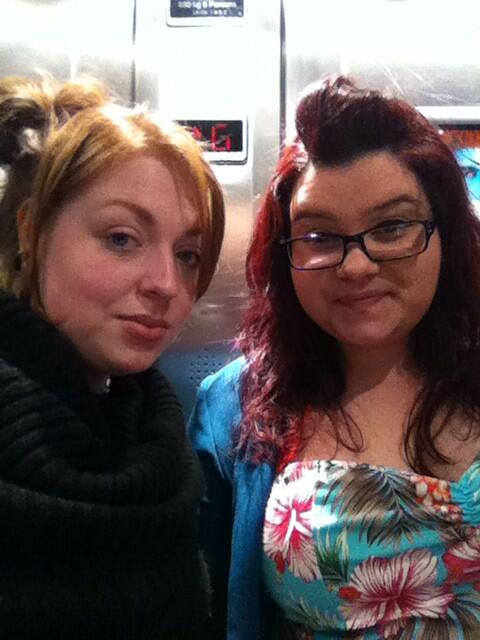
                                                (Pippa and I with out In-the-lift-pre-poetry-selfie!)


Last night I had an amazing time at Hit the Ode Manchester edition. I'd heard a bit about this event on Facebook in the lead up and knew a bit about Apples and Snakes previously, but thanks to not being near any of the events I hadn't been able to experience these shows before.  It was a night where I truly felt Spoken Word was on the rise. We hear a lot about how no-one likes poetry anymore and it's a dying art but last night proved that all wrong. A lot of the venue's we end up in are top rooms of pubs or small art cafe's, which are amazing and I enjoy my time there but it was really nice to see poetry on a bigger stage.

To begin with the event was so well organised. It was at Contact in Manchester, a venue I haven't been to before but one that I will be at again! The venue itself was perfect for the night, but I was sat at the front with my lovely friend Pippa!
    The compares were brilliant, really funny and engaging. These nights have been going on for quite a while, a few years in Birmingham too, so they have a few traditions that they shared with us. It made us feel part of a poetic collective which was very empowering.
    At the beginning was an open mic section with a few very organised people in the slots. These were very good poets and it really made you see how amazing some people out there are. There were also three slots for people who came on the night. Although neither myself or Pippa got to read the readers were great fun to watch.

     The next bit of the show was more established performers.

 Rosie Garland performed first. Although I've read her work I only had the chance to see her perform at Loose Muse briefly so it was a pleasure to see her do a full set. If I'm honest this is the main reason I wanted to go! She didn't disappoint! Amazing stage presence and beautiful poetry, really a cracking combination. Garland's poetry is stuffed to the brim with gems of imagery with poems like
about (but not about) unicorns, topped with her very funny poems like being a Teenager in Devon and satirical work like Queer Thanksgiving which made me laugh and question society all at the same time!

Next was Jamine Cooray, a spoken word artist I hadn't hear before. It was refreshing to hear something different! Cooray takes vivid imagery from her childhood and disperses it throughout her work, she has a very modern style that can objectively examine itself well. I was particularly  impressed with her self-made poetry pamphlets which were adorable and a great idea.

                                   Last but definitely not least was Shane Koyczan.                                                          
I'm ashamed to say I hadn't really heard him before. I feel like I've seen his face on youtube and shared around but I hadn't taken the time to sit down and listen to his poetry. In a way I'm glad of this because the performance was so new to me I appreciated everything, the movement of his hands blended seamlessly into his poetry. I'm not ashamed to say I teared up a bit with his poem about his Grandad!

I really hope there are more of these to come! Check these amazing artists out on youtube and elsewhere!


Tuesday, 4 March 2014

Misadventure by Richard Meier - Review

So, essentially I came to this book knowing nothing about it, or Richard Meier and a lot about Picador's poetry collections. 
Misadventure is a collection of characters, atmosphere's and moments on the cusp of change. The poems themselves seemed concerned only with the fleeting moment before change strikes, or in the grip of change before it is fully realized. The composition of the book struck me first, before 'Building Matilda' there is a cluster of darker poems; I preferred these. After 'Building Matilda' there is a change in tone that drew me back into reality and out of middle distance where I personally prefer poetry to inhabit. I found Meier's writing extremely accessible, it reminded me in places - particularly when Father's appeared in poems like 'Building Matilda' - of Billy Collins. 


'Winter Morning' is a glimpse of commuters readily prepared for the cold morning who are taken off guard by the emergence of spring. My favourite line of this poem was 'And not quite under the shelter on / the northbound platform, an old man, the sun'. I was mesmerized by the double imagery in this, this set me up to seek out those unique interpretations of ordinary life in the subsequent poems. 
It then moves on to the title poem 'Misadventure', I loved the way this poem turned from overly ordinary to downright bizarre! It has a very fast flow to it, and at times I had to make sure I wasn't missing any detail throughout that set up the ending. It provokes a guttural reaction, at first you can feel the water on your trouser-leg and the pressure in you mouth, if you've ever opened your mouth in the shower. 
The poems aren't just on the cusp of life changing decisions as with 'For a Bridge suicide', some are so subtle that they could be missed! 'Fabric' has this effect, again a very tangible feeling, but one that goes unnoticed in everyday life, the feeling of silk. Ending in the words 'as I reached for her.' A re-reading it reminds me of biblical imagery.
A refreshing element of this collection is the way that Meier brings inanimate objects like chair's and bird feeders to life, sometimes through the touch of a character, as in 'The Feeder'; or with its simple existence, like in 'Psychotherapy'. I'm at a loss, not wanting to term it personification but I feel that Meier delves into their own 'spirit' without attributing to many human qualities to them.
I'm excited to see what Meier comes out with next. This collection has an air about it of a writer who's compiled his life up to now into this. It's raw in places and that blends with the most polished line breaks and story development in certain poems. Meier seems like an everyman writer, like most of us first timers, waiting behind an email address; so it's nice to see that there are still a lot of chances out there for all of us.


Sunday, 2 February 2014

Lullaby by Chuck Palahniuk - Review

Someone told me that you always remember your first Palahniuk. After reading Lullaby I can see why. 
     Following Carl Streator is definitely 5 giant steps away from the Donna Tart I had just finished, or the Neil Gaiman I'm about to start. I wouldn't go as far as saying that he's one of a kind, but whatever he's doing, he's a master of it. 
      I feel very priviledged to think that we live in possibly the most diverse literary age there as ever been, considering those are a handful of the more mainstream contemporary authors. The diversity available to the modern reader is astounding. (You go, 2K14). 

           As I said before, Lullaby follows Carl Streator across various locations in America as he simultaneously tracks down first the culling song and then the grimoire it came from. It reads like a futuristic version of Dennis Wheatley. An intoxicating cocktail of old school occultism, post-modernism and B-movie horror.  
    Whilst reading - I was reading it on my kindle app which effected my pace - I found myself able to stop a lot, at times forced to, to decode and analyse what Palahniuk was pointing out to me. This book takes a lot of concentration from the reader, which is both exhilerating and hard going.  
     When I got to the end though I was miffed! I really could have kept reading a 100 more pages. Lullaby felt a lot like an extended short story, a metaphorically rich gif, rather than a snapshot of life. The running themes, or "horses" as Palahniuk calls them, carry this novel in a round, the repetition is both contemplative and progressive in that respect. The narrative voice is stead, mimicking the sound of Helen Hoover Boyle or Nash as they read the culling song. 
      The highlight of this novel for me is the imagery, I revelled inthe oozing sores of Streator's blisters and the diamond encrusted bloody gums of Ms. Boyle. Thos is where I likened it to a B-movie horror, if anyone has watched Horror in the Attic, it is quite similar. 
    I'd heard a lot about Palahniuk before starting Lullaby, mostly about Fight Club, my tutor advised me not to run off though and try some other work by him before readjng that. 
     I feel ready to read Kurt Vennegut finally now, but I've no idea why they are linked in my head.

Thursday, 12 December 2013

Blood Red Snow White - Review

Isn't it magical how you approach books? I saw this in W. H. Smith about 5 years ago and before I'd even read the title I was hooked on it. I have the hardback edition, and I genuinely feel that the texture of the pages, the colour of the writing, the beauty infused to it to submerge the reader into it's world. Well played Orion Books.

When people ask me for book recommendations I always mention this one, it's in my top list and has been there since I read it, which is an achievement because I'm the magpie of the book world. And I will tell you for why...
     
                        Set in the grip of Russia's communist revolution Blood Red Snow White is a mix of historical fiction, creative non-fiction, biography, fairy tale, spy thriller and love story. Squished into 300 pages. I was impressed by the sheer amount of trust that Sedgwick has in his readers. To mix these genre's take guts for the writer, but patience from the reader to allow them to flit and pick between mediums. This is combined with a distinctive 'Sedgwick' tone. The best analogy for this book is to imagine it on top of a black (red) Venetian mirror, and just when temptation gets too much and you reach out to take it you realise that is has been behind the mirror all along.
                             I have studied the Russian Revolution (GCSE History came in handy!) and so I 'got' many of the references to Russian culture at that time, the research that has gone into this novel is brilliant. However, the novel is beautiful even if you don't know a lot.
                           There are several layers of view point in the novel, you have the fairytale Bear of Russia following in the shadows adding in beautiful interludes of passion and fantasy. Alongside that there is the background of the revolution literally overthrowing and transforming a country. Out of the mist comes Arthur Ransome, broken from a love-less marriage and the love for his daughter, and consumed with trying to collect the pieces of the revolution, not to help the country but to report back to England. It is here that the reader is given a HQ, which allows them to wonder, guided, through the streets of the broken jigsaw that is Russia.
                          The first two sections of the book play out like this, the first being mainly fairy tale-esq and the second more spy thriller with the historical and biographical supporting it all. The third section has had a bit of bad press from reviews and I can understand that. Taking into account that Sedgwick is a pre-adult writer the final part had to happen as it does. It still has the beautiful gothic undertones but hurries to neaten the package to some extent. However, I felt for the characters until  page 304 and beyond, I'm pretty sure that's all that matters.


Tuesday, 19 November 2013

Monday, 18 November 2013

Enron by Lucy Prebble - Review

Enron by Lucy Prebble opened at Chichester Festival Theatre in 2009, transferred to the Royal Court Theatre to the Noël Coward Theatre in 2010 where it was a huge success. Enron also opened in America Enron premiered on Broadway at the Broadhurst Theatre on 8 April 2010 in previews, with the official opening on 27 April.

  Enron lets the viewer into the bubble of Enron and explores the prism that is creates for itself. Naturally the only way to get the audience out is to burst that bubble. The writing is excellent. There are full sweeping speeches that examine the intricate details of finance and the company whilst making these details accessible to the audience. Anyone I know will tell you that money, maths or business are my major weaknesses, and yet I enjoyed reading this play a lot. The large speeches are offset by small, quick dialogue between Lay and Roe or Skilling and Farlow, the play continues interchanging these modes of dialogue, the effect is that the audience is kept alert, waiting and on edge to see how the play will settle itself. Spoiler: it won't, it continues until the en to interchange. This effect mimics the development of Enron in the play, how it shifts around to transform and emerge only to transform again until the end of the play.
                   I particularly enjoyed the chaos. I Youtube-d the play so that I could see how the play moved. The blend of dance and music, of projection and theatricality seemed the perfect way to represent what really happened when the biggest oil and gas company of America fell.
                The characters are formed very differently, at times you like them and at times they seem very transparent but it is the blend of the faults of each character that reflect the whole of the play. Unfortunately I was only about ... 10 when Enron fell so I am coming to this play from a completely different perspective with only the hindsight of the credit crunch to fall back on as my experience of what it's like to see a company fall. With Enron being the biggest and first company to fall it feel weird to think that wasn't the norm ten years ago.
              The play does a great job of presenting the size of the crash for Enron, I think this is a great credit to the play and another reason that the media's are mixed so much. I don't think that theatre alone could have represented it so well. The whole play has a grunge / fringe feel about it, mixed with the office setting and the suit's it shows just how innovative the ideas where and how much they were playing with the future. The fringe feel allows the Prebble to stretch her voice past theatre and into the larger question.


 You can watch the trailer for the play HERE
You can also read more about Lucy Prebble and 4 other contemporary playwrights in a piece I've written for For Books Sake

Friday, 27 September 2013

The Wasp Factory by Iain Banks - Review

This is Iain Banks first novel from 1984, and it is the first Iain Banks novel I have ever read. This has been sitting, lonely, on my shelf for about a year and I had every intention of reading it a hundred times. If I'm being honest, the size of the novel makes it convenient to read, sitting comfortably in the hand at 184 pages. Don't be fooled by this! This is 184 pages of beautifully uncomfortable reading. I am equally impressed and disturbed by this novel, slightly worried I haven't let this novel settle into my mind and that I am writing this review too soon, having finished the novel 10 minutes ago. That is the intelligence of this novel, it forces you to sit down, back straight and pay attention to it. If you laze around reading a page or two at a time you're likely to miss the fine details, and then loose the plot. At one point, and you'll know where I mean, I had to hand this book to my partner as I couldn't continue reading, I couldn't even bare to have it in my bag, but that lasted about 5 seconds before I just had to know what was going to happen.  This novel doesn't give the game away at any point, even the ending is a slow burner, but the more I think about it the more I want to chew over the finer images of fire and running, drunken haze's and kite flying.
                            
The novel follows an *cough* eccentric period in the eccentric life of Frank as he methodically grooms and cultivates the island that is his home. In the process we discover some of Frank's achievements and are given an in-depth view of Frank's mind. It's a journey,  pack a cheese sandwich and an apple in that backpack and be prepared to ramble the dunes. The blurb gives away that Frank has killed three people, children, two cousins and his brother, two boys and one girl, and these murders dropped from a great height *still a bit raw!* fall into the lap of reader and force you to accept them and move on, or you'll miss them. Murder mingles with animal abuse and the border line of sanity and insanity are amongst the side lines. The relationship of a secluded family with a history of macabre, and how these twisted jigsaw pieces fit together is the true plot of this novel. 
The imagery contained in Banks novel is beautiful, set on the north-east coast of Scotland and allows for a connection between plot and  nature that accentuates and isolates all characters in the novel. The glory of nature is juxtaposition against the mechanical thinking and construction that Frank takes out on the island itself. Turning beautiful rolling sand dunes into dams, or erecting poles high in the sky that will break up the horizon line and a step further adorning them with the dried heads of gulls and mice, or the occasional cat. There is a real fight in this novel between nature and human intervention, which leads subtly to the end of the novel.